Key Factors That Determine Quality in Casting
Casting is much more than pouring molten metal into a mold. It is a comprehensive manufacturing process in which material knowledge, mold preparation, process parameters, finishing operations and quality control must work together consistently. The dimensional accuracy, mechanical properties, surface quality and service life of a cast component are directly influenced by the controls applied throughout every stage of production.
At Soylu Döküm, we combine the manufacturing experience we have developed since 1969 with evolving industrial requirements and modern production methods. In our production of gray iron, ductile iron, steel, Ni-Hard and various steel derivatives, each component is evaluated according to its specific technical requirements. Our approach is based on selecting the appropriate material, applying the right manufacturing method and maintaining controlled production processes.
Correct Material Selection
The foundation of a high-quality casting begins with selecting the appropriate material. Operating conditions, mechanical loads, working temperatures, wear conditions and expected mechanical properties are among the primary factors that should be considered when determining the material for a component.
Casting requirements can vary significantly between industries such as automotive, agricultural machinery, mining, valve and pump systems, machinery manufacturing and general industry. For this reason, a material must not only be suitable for casting but also provide the characteristics required under the actual operating conditions of the finished component.
Molding and Core Preparation
Molding is one of the critical stages that directly influences the geometry and surface characteristics of a cast component. Proper mold and core preparation helps reduce potential casting defects and contributes to achieving the required component geometry.
For industrial components with complex geometries, core structure, mold design and process parameters should be considered together. Careful preparation at this stage provides a stronger foundation for stable and repeatable production.
Controlled Casting Process
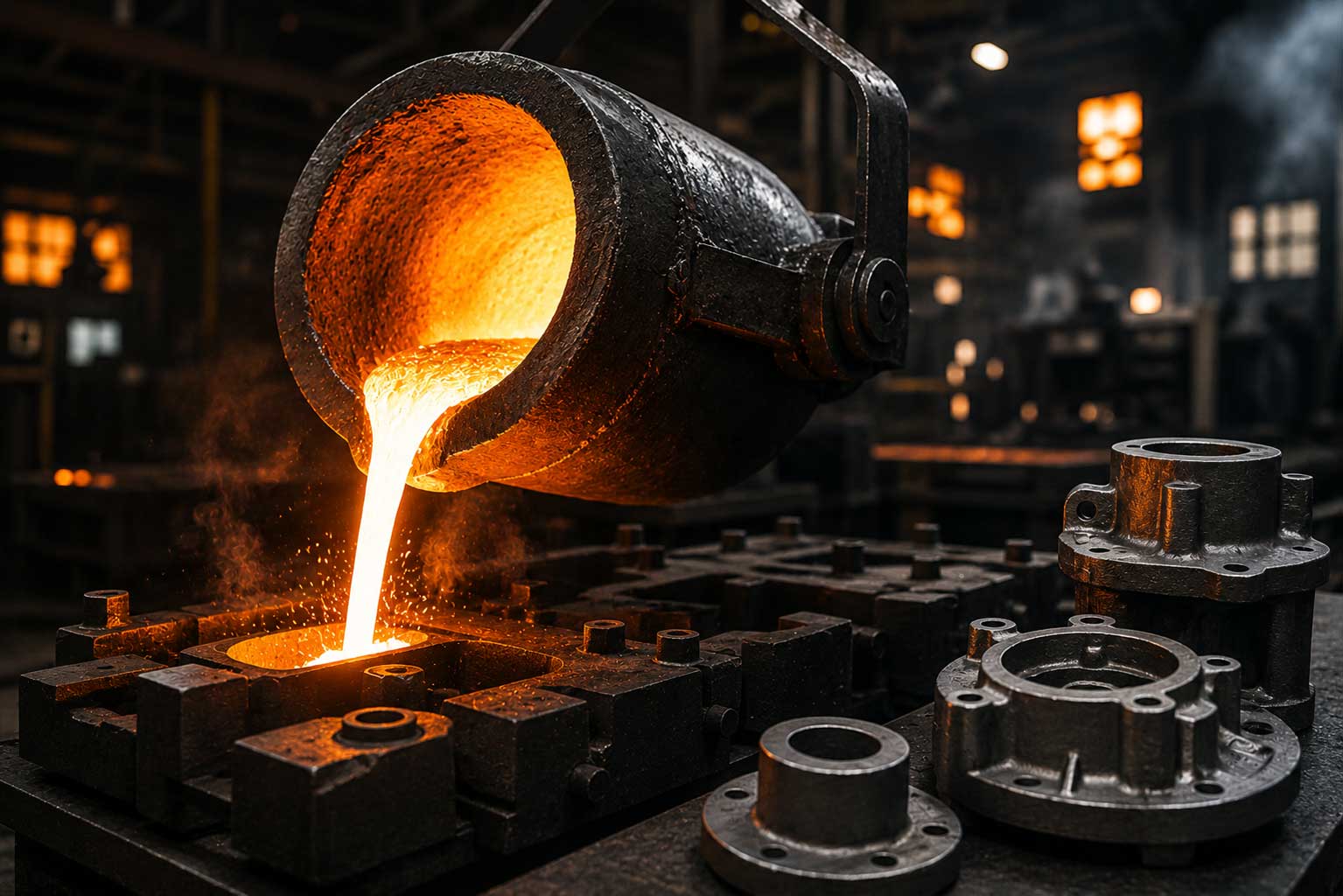
Maintaining control over process variables, including molten metal temperature and pouring conditions, is essential for achieving consistent casting quality. Controls performed during casting affect not only the quality of an individual component but also the repeatability and stability of future production.
At Soylu Döküm, production processes are planned by considering technical requirements, material characteristics and component geometry. This approach aims to establish suitable manufacturing conditions for cast components used across different industries and applications.
Cleaning, Grinding and Heat Treatment
Completing the casting operation does not necessarily mean that the manufacturing process is finished. Cleaning and grinding operations prepare cast components for subsequent manufacturing stages or their intended applications. Depending on technical requirements, heat treatment may also play an important role in achieving the desired mechanical properties.
Controlled execution of these processes can have a direct impact on the performance, reliability and service life of the final component.
Quality Control as an Integral Part of Production
Quality in casting should not be considered only as a final inspection performed after production. A comprehensive quality approach needs to be integrated into the entire manufacturing process, from raw material evaluation to the finished component. Dimensional inspections, material evaluations and process monitoring help ensure that production progresses according to defined requirements.
At Soylu Döküm, we consider quality not as a separate stage but as a common principle across our manufacturing processes. With a production area of 20,000 m² and an annual production capacity of 3,600 tons, we provide casting solutions for different industrial sectors while delivering a significant portion of our production to international markets.
By combining our experience dating back to 1969 with today's manufacturing requirements, our goal is not only to produce cast components but also to establish reliable, sustainable and long-term manufacturing partnerships with our customers.